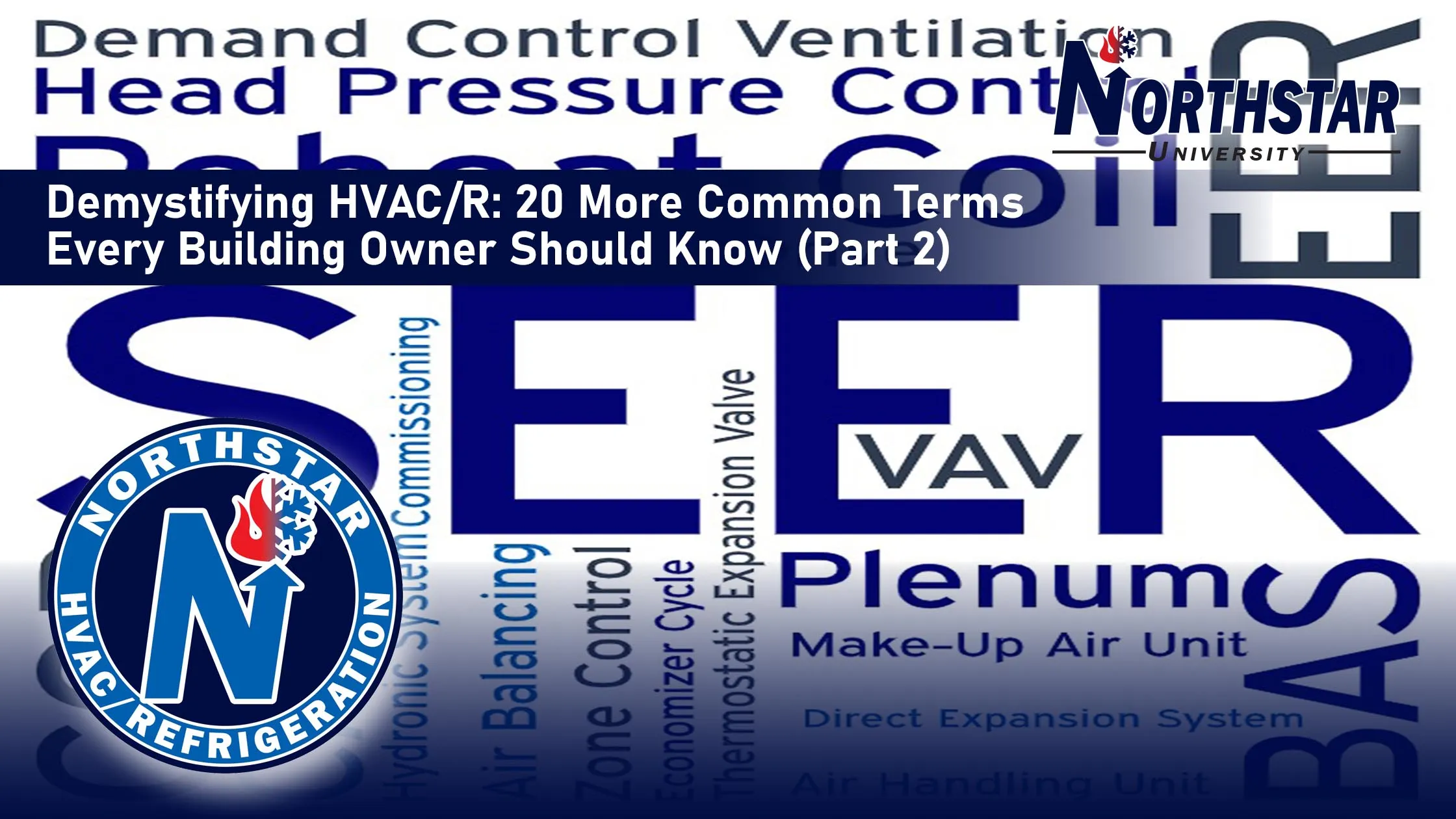
Demystifying HVAC/R: 20 More Common Terms Every Building Owner Should Know (Part 2)
In our first installment of Demystifying HVAC/R, we broke down 20 essential terms every building owner should know. From compressors and condensers to SEER ratings and refrigerant types, those fundamentals gave you a solid foundation for understanding your heating, ventilation, air conditioning, and refrigeration systems.
Now it's time to go deeper.
In Part 2, we're tackling 20 more terms that come up in maintenance conversations, energy audits, system upgrades, and compliance reviews. These are the concepts that help you make informed decisions, communicate effectively with your service providers, and keep your building running smoothly year-round.
Whether you're a seasoned facility manager or new to building operations, this glossary is designed to be a practical reference you can return to again and again.
Let's get into it. 👇
1. Dry Bulb Temperature
The standard air temperature measured by a regular thermometer, unaffected by moisture. It's the baseline measurement used in most HVAC calculations and load assessments.
2. Wet Bulb Temperature
A temperature reading that factors in humidity. Measured using a thermometer wrapped in a wet cloth, it reflects how effectively the air can absorb more moisture. It's critical in cooling tower performance and humidity control.
3. Enthalpy
The total heat content of air, combining both temperature and moisture. HVAC systems use enthalpy to determine the most efficient way to condition indoor air.
4. Load Calculation
An engineering analysis used to determine the heating and cooling demands of a building. It factors in building size, insulation, occupancy, equipment, and local climate to properly size HVAC systems.
5. Commissioning (Cx)
A quality assurance process that verifies HVAC systems are designed, installed, and operating as intended. Commissioning is typically performed when a new system is installed or after a major retrofit.
6. Retro-Commissioning (RCx)
Similar to commissioning, but applied to existing buildings. RCx identifies inefficiencies in current HVAC operations and recommends low- or no-cost improvements to optimize performance.
7. Economizer
A component of an HVAC system that uses outdoor air to cool a building when conditions allow, reducing the need for mechanical cooling. Common in rooftop units and air handlers.
8. Demand-Controlled Ventilation (DCV)
A ventilation strategy that adjusts outdoor air intake based on real-time occupancy levels, typically using CO2 sensors. It improves indoor air quality while reducing energy waste.
9. Psychrometric Chart
A graphical tool used by engineers to visualize the properties of moist air, including temperature, humidity, enthalpy, and dew point. It's essential for designing and troubleshooting HVAC systems.
10. Dew Point
The temperature at which air becomes fully saturated and water vapor begins to condense. Monitoring dew points is important for preventing condensation-related issues in buildings and cold storage environments.
11. Air Changes Per Hour (ACH)
A measure of how many times the air in a space is completely replaced in one hour. Higher ACH rates are important in hospitals, labs, and clean rooms, while standard commercial buildings may require fewer.
12. Static Pressure
The resistance to airflow in ductwork and HVAC components. High static pressure can indicate blockages, undersized ducts, or dirty filters, all of which reduce system efficiency.
13. Variable Frequency Drive (VFD)
An electronic device that controls the speed of motors in HVAC systems (like fans, pumps, and compressors). VFDs reduce energy consumption by matching motor speed to real-time demand instead of running at full capacity.
14. Coefficient of Performance (COP)
A ratio that measures the efficiency of a heating or cooling system by comparing the energy output to the energy input. A higher COP means greater efficiency.
15. Thermal Expansion Valve (TXV)
A precision device that regulates the flow of refrigerant into the evaporator coil based on system demand. It ensures optimal cooling by preventing both overfeeding and starving the coil.
16. Superheat
The temperature of refrigerant vapor above its boiling point. Monitoring superheat helps technicians ensure the evaporator is functioning properly and that liquid refrigerant doesn't enter the compressor.
17. Subcooling
The temperature of liquid refrigerant below its condensing point. Proper subcooling indicates the condenser is operating efficiently and the system has the correct refrigerant charge.
18. ASHRAE Standards
Guidelines published by the American Society of Heating, Refrigerating and Air-Conditioning Engineers. Key standards like ASHRAE 90.1 (energy efficiency) and ASHRAE 62.1 (ventilation) influence building codes and system design across the industry.
19. Title 24 / Energy Code Compliance
Refers to energy efficiency standards set by state or local governments (Title 24 is California's code, but similar standards exist in other states like Massachusetts). Compliance impacts equipment selection, insulation, lighting, and HVAC design.
20. Fault Detection and Diagnostics (FDD)
Technology built into modern HVAC systems that automatically monitors performance and alerts operators to issues like refrigerant leaks, sensor drift, or mechanical faults. FDD helps reduce downtime and improve energy efficiency.
Why These Terms Matter
Even if you're not turning wrenches, understanding this language helps you:
- Ask better questions during maintenance visits
- Evaluate proposals and bids with more confidence
- Identify inefficiencies before they become expensive problems
- Communicate more effectively with engineers and contractors
The more fluent you are in HVAC/R terminology, the more empowered you are as a building owner or facility manager.
Ready to Put This Knowledge to Work?
At Northstar Refrigeration, we believe that informed building owners make the best partners. Whether you're planning a system upgrade, scheduling preventive maintenance, or just want to better understand your building's mechanical systems, our team is here to help.
📞 (508) 888-3692
Learn more about our commercial HVAC services, or contact us to schedule a consultation.
Do you have questions about this topic?
📧 Email sales@northstarhvacr.com to discuss predictive maintenance and monitoring options for your business.